
AI Search Visibility for B2B Firms: What Makes Expertise Easier to Find and Trust

The most important question is not whether ChatGPT, Perplexity or Google’s AI features mention your business.
It is whether an unfamiliar prospective client can quickly understand what you do, why it matters, where you are credible and whether you are worth speaking to.
AI is changing how people research complex services, unfamiliar technologies and potential suppliers. A prospective client may still find your business through Google, a referral, a LinkedIn post, or an industry recommendation. But they may now also use ChatGPT, Perplexity, Google’s AI-enhanced search experiences, or another AI-assisted tool to clarify a problem, compare approaches, identify potential suppliers, or prepare for an internal discussion.
Forrester reported in early 2026 that 89% of business buyers use AI somewhere in their buying process. That does not mean AI has replaced professional judgement, referral networks, procurement processes or relationship-led B2B buying. It means AI has become part of the research environment in which those decisions begin. Forrester: B2B Buyers Make Zero-Click Buying Number One
For expert-led B2B businesses, this raises the standard.
Your website and wider digital presence need to do more than contain the right keywords. They need to make your expertise easy to interpret: clear enough for the right buyer to recognise relevance, specific enough to establish confidence, and well-supported enough to justify a next step.
That is the practical challenge behind AI search visibility.
If you are unsure whether your website is making the right expertise easy to find, understand and trust, an AI Search Visibility & Website Readiness Review can help establish what is holding it back.
AI Has Changed the Research Layer
AI has not replaced professional judgement, referral networks, procurement processes or relationship-led B2B buying.
It has changed part of the research layer that sits before them.
A senior decision-maker may use an AI tool to clarify unfamiliar terminology, identify possible approaches, compare service models or make sense of a specialist market before beginning a more focused search. They may use it to prepare for an internal conversation, shape an early supplier longlist or decide which websites deserve closer attention.
This matters because many B2B buying journeys begin well before there is a formal brief, procurement process or shortlist.
A buyer may ask questions such as:
What does a retrofit strategy need to consider for a complex occupied building?
Which types of consultants are involved in a net-zero programme?
How do we assess a deep tech solution before a pilot?
What is the difference between a marketing strategy, a brand strategy and a digital growth plan?
What evidence should we expect from a specialist supplier in this sector?
Which firms have relevant experience with a particular type of project, technology or challenge?
The organisations that are easiest to understand at this stage are better placed to be considered later.
That does not mean a business needs to appear in every AI-generated response. It means it needs to communicate its expertise in a way that is useful, credible and accessible when the right buyer begins looking.
AI-Assisted Research Starts With a Buyer Question
AI-assisted research can happen at several points before a prospective client contacts a business. The platform may change – Google, ChatGPT, Claude, LinkedIn, or a referral – but the underlying question is usually commercial, practical, or risk-related.
The website that performs best is not necessarily the one with the most content. It is the one that helps the right visitor answer the question that brought them there.
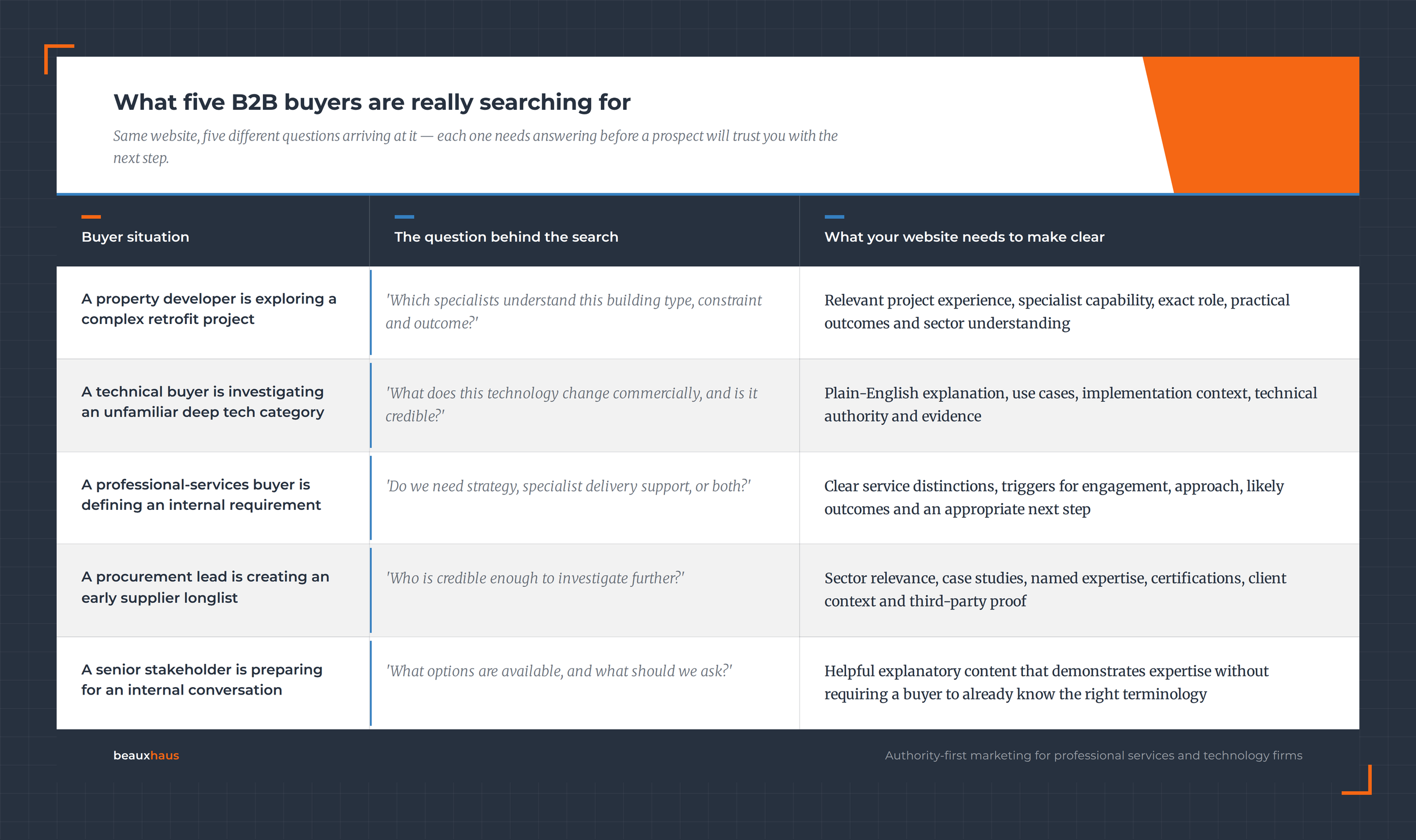
-
A property developer exploring a complex retrofit project:
Question: Which specialists understand this building type, constraint and outcome?
Website needs to make clear: Relevant project experience, specialist capability, exact role, practical outcomes and sector understanding.
A technical buyer investigating an unfamiliar Deep Tech category:
Question: What does this technology change commercially, and is it credible?
Website needs to make clear: Plain-English explanation, use cases, implementation context, technical authority and evidence.
A professional-services buyer defining an internal requirement:
Question: Do we need strategy, specialist delivery support, or both?
Website needs to make clear: Clear service distinctions, triggers for engagement, approach, likely outcomes and an appropriate next step.
A procurement lead creating an early supplier longlist:
Question: Who is credible enough to investigate further?
Website needs to make clear: Sector relevance, case studies, named expertise, certifications, client context and third-party proof.
A senior stakeholder preparing for an internal conversation:
Question: What options are available, and what should we ask?
Website needs to make clear: Helpful explanatory content that demonstrates expertise without requiring a buyer to already know the right terminology.
The common thread is not a particular AI platform. It is whether your expertise is sufficiently clear, specific and well-evidenced to help a prospective client make sense of a complex decision.
The Issue Is Often Clarity, Not AI
Many specialist firms have substantial expertise but present it in ways that are difficult for a prospective client to interpret quickly.
The problem is rarely that the business lacks valuable experience. More often, its experience is scattered across senior people, proposals, project work, technical documents, presentations and internal language that makes sense to colleagues but not necessarily to an unfamiliar visitor.
A business may be genuinely excellent, but still leave a prospective client asking:
What exactly do they do?
Who are they best suited to help?
What makes them different from other plausible options?
Have they solved a problem like ours before?
Do they understand our sector, project type, or commercial context?
What should we do next if we want to explore this properly?
If a buyer cannot answer those questions from your website, they may not investigate further – even if the underlying work is excellent.
Deep Tech Companies
A deep tech company may explain a technically sophisticated product without making its commercial significance clear to a prospective buyer.
The website may describe the underlying science, platform, or engineering in considerable depth while leaving unanswered questions about the customer problem, the operational context, the adoption pathway, or the value of choosing this solution over an existing alternative.
This is a recurring issue in deep tech marketing, where the challenge is not to simplify the expertise beyond recognition. It is to translate technical credibility into a compelling, commercially relevant reason for the right audience to engage.
Architecture and Engineering Practices
An architecture or engineering practice may show impressive work but leave visitors uncertain about its precise role, specialist experience or relevance to their project.
A project gallery alone may not explain whether the practice led the design, delivered a particular technical discipline, worked on a comparable building type, handled a particular planning or sustainability challenge, or has relevant experience at the required scale.
Effective marketing for architecture and engineering practices makes the relationship between project evidence, specialist capability and a client’s decision much clearer.
Professional-Services Firms
A professional-services firm may list broad capabilities while making it difficult to distinguish when each service is needed, what makes the approach credible or which conversation a prospective client should begin with.
A service list is not always a proposition. Nor is an impressive client logo strip necessarily evidence that the firm can solve a specific problem for a particular buyer.
Stronger marketing for professional-services firms helps turn specialist knowledge into clearer services, better-connected proof and more relevant business-development conversations.
These are not simply content problems.
They affect how a business is understood, remembered and evaluated. When the offer is unclear, the proof is disconnected, or the route to contact is weak, the website can underperform even where the work itself is excellent.
AI Search Visibility Is Not a Platform Tactic
Terms such as AI search optimisation, Generative Engine Optimisation and Answer Engine Optimisation are now widely used to describe this area.
The labels are less important than the underlying principle.
There is no responsible way to guarantee that ChatGPT, Perplexity, Google or another AI platform will mention a business, use a particular page as a source or describe an offer in exactly the way a business would prefer.
These systems change continually. Their outputs depend on the question asked, the information available, the sources selected and the context in which the answer is generated.
Google’s guidance is a useful corrective to some of the hype surrounding AI search. There is no separate AI index, no special ‘AI Overview schema’ and no technical shortcut that guarantees inclusion. Google continues to emphasise the foundations of good search visibility: accessible and indexable content, useful text, clear internal linking, structured data that reflects visible page information and a technically sound website. Google Search Central: AI Features and Your Website
That does not make AI-assisted discovery irrelevant.
It makes shortcuts less credible.
The businesses most likely to be understood well during AI-assisted research are usually those with a coherent offer, useful source material, visible evidence, clear language and a website that helps a prospective client move from curiosity to confidence.
Signals Buyers and AI Systems Can Work With
AI systems do not make commercial decisions. People do.
But both prospective buyers and search technologies depend on signals that help them interpret what a business does, why it is relevant and whether it is credible.
Those signals include:
Clearly named services, with an explanation of when and why each is relevant
Specific sector, audience or project context rather than broad capability statements
Named experts whose experience and point of view are visible
Case studies that explain the client challenge, the role played, the work completed and the outcome
Useful explanations of specialist terminology in language a non-specialist stakeholder can follow
Relevant articles, guides and insight that demonstrate genuine expertise rather than repeat generic advice
Consistent information across service pages, case studies, articles, LinkedIn profiles and relevant third-party sources
Accurate structured data that reflects visible information on the website
Clear internal links that connect related services, sector expertise, projects and supporting content
An appropriate next step for someone interested but not yet ready to buy
None of these is a magic ranking factor.
Together, they make it easier for the right people to understand the business – and give search engines and AI systems more useful, reliable material to work with.
Visibility Is Not the Same as a Business Outcome
A citation, mention, or appearance in an AI-generated answer can be useful.
It may create awareness. It may introduce a business to a buyer who had not encountered it previously. It may reinforce an existing impression of authority.
But an AI citation is not automatically a commercial outcome.
A mention does not necessarily mean:
The person searching is the right prospective client
They understand the business accurately
They have seen the evidence behind the claim
They are ready to make contact
The website gives them a compelling reason to continue
The business is well positioned for the type of work they need
The distinction matters because AI-generated summaries may change how selectively people click through to a website.
Pew Research Center’s 2025 study of Google search behaviour found that users clicked a traditional result link on 8% of visits where an AI summary appeared, compared with 15% of visits where no AI summary appeared. Links within the AI summary itself were clicked much less often. Pew Research Center: Google Users Are Less Likely to Click Links When an AI Summary Appears
This is not a reason to assume that websites no longer matter.
It is a reason to make every serious visit count.
If a buyer arrives after using an AI tool to clarify their thinking, they may be more informed, more selective and closer to a decision than a broad early-stage search visitor. A vague homepage, generic service page, or disconnected case-study library is then more likely to lose their attention.
The goal is not simply to be visible.
The goal is to ensure that, when the right buyer reaches your website, they can understand why your business is relevant and what they should do next.
Why a Visibility Scan Is Not a Strategy
It is now easy to run a low-cost AI visibility scan.
A tool can submit a limited number of prompts, report whether a business appears and generate a list of generic recommendations. This can provide an interesting snapshot. It may reveal how a brand is currently represented in a narrow set of answers or whether important competitors are being mentioned.
But it is not the same as a meaningful diagnosis.
A scan cannot reliably establish:
Whether you are visible to the audience that matters most commercially
Whether your business is being represented accurately
Whether the prompts tested reflect real buyer questions or decision stages
Whether your website clearly explains the offer
Whether your available proof supports the commercial message
Whether your service pages distinguish your business from credible alternatives
Whether prospective clients can find a relevant next step
Whether the main constraint is visibility, clarity, credibility, conversion or something more fundamental
The important question is not simply:
‘Does an AI tool mention us?’
It is:
‘What is preventing the right prospective clients from finding, understanding and trusting us when they are deciding whom to speak to?’
That question requires context.
It requires an understanding of the commercial audience, the business model, the website, the existing evidence, the search landscape and the wider route from attention to a useful conversation.
A Strategic Growth Review is designed to answer that question by identifying the priority constraint and the most valuable direction to take next.
What a Useful Review Should Investigate
A useful AI search and website review should not begin by counting brand mentions.
It should begin by understanding the commercial question a prospective buyer is trying to answer – and testing whether the current digital presence provides enough evidence to answer it.
That means investigating questions such as:
Which audiences, sectors and buying situations matter most to the business?
What language do prospective clients use before they know the exact name of the service they need?
Which services are clearly differentiated, and which are blurred together?
Where does evidence sit, and does it support the claims being made?
Which pages help a buyer make a decision, rather than simply describe capability?
Can search engines and AI systems access, interpret and connect the relevant material?
Are there technical, structural or content barriers limiting discovery?
Where does interest currently stall: discovery, understanding, trust, enquiry or follow-up?
Is the existing marketing activity helping to create the right business-development conversations?
The answers will differ from one business to another.
For one organisation, the limiting factor may be an unclear service proposition. For another, it may be weak evidence, fragmented website journeys, thin sector content, a poorly structured site or uncertainty around the action a visitor should take.
The priorities are different because the underlying constraint is different.
A Clearer Digital Presence Supports Better Decisions
The businesses most likely to benefit from AI-assisted discovery are not necessarily those chasing every new platform feature.
They are the businesses whose digital presence makes it easier to understand:
What they do and why it matters
Which clients, sectors or project types they are best suited to help
What experience supports their point of view
How their services relate to a buyer’s commercial or technical problem
Why their approach is credible
What a prospective client should do next
This is a broader standard than visibility alone.
It brings together how a business is positioned, how its expertise is expressed, how its website supports discovery and how its marketing creates enough confidence for a prospective client to act.
For firms looking to make expertise more consistent across websites, content, proposals and AI-supported work, our guide to AI brand intelligence explains why a stronger, more coherent knowledge base matters.
The Role of SEO in AI-Assisted Discovery
SEO remains essential.
A clear, well-structured and technically sound website gives search engines – and the people using them – a stronger basis for understanding your business. It supports the discovery of core services, sector expertise, project evidence and thought leadership.
This includes familiar SEO fundamentals:
Pages that are accessible to search engines and users
Clear information architecture and descriptive internal links
Service pages built around real buyer needs rather than vague capability labels
Relevant case studies and project evidence
Useful, original content that demonstrates genuine expertise
Accurate titles, headings, metadata and structured data
Mobile-friendly pages that load reliably and are easy to use
Clear conversion paths from research to enquiry
These foundations matter because AI-assisted tools do not remove the need for a useful website.
They may influence how a prospective client first encounters a business. But a well-considered article, case study or service page gives a buyer much more than a short AI-generated summary can provide. It shows how your business thinks, what experience it brings and whether its approach is relevant to a real commercial situation.
AI-assisted research may change how people arrive at a website.
It does not remove the need for a website that deserves their attention once they get there.
What Not to Do
There is understandable pressure to respond quickly to changes in AI search.
But B2B firms should be cautious about treating every emerging tactic as a strategic priority.
Publishing generic ‘AI-optimised’ articles, adding FAQs to every page, applying schema markup without improving the underlying content, chasing prompt mentions or paying for a dashboard that counts citations may create activity.
None necessarily resolves a weak proposition, missing proof, unclear website journey, or lack of commercial relevance.
A new acronym, an automated scan, or a short-lived platform feature does not automatically address the business issue underneath.
AI search is not a reason to abandon SEO, case studies, subject-matter expertise, service-page clarity or thoughtful conversion journeys.
It is a reason to make those assets more coherent, more useful and easier for the right audience to interpret.
A Measured Approach Matters
The detail of AI search will continue to change.
Google’s AI features evolve. Claude and Perplexity change how they surface information. New tools, new formats and new measurement platforms will appear. The proportion of searches that trigger AI-generated answers will fluctuate by market, query type, geography and platform.
The strategic questions are more stable:
Is the business easy for the right audience to understand?
Does the website communicate a clear and credible offer?
Is relevant expertise supported by meaningful evidence?
Can prospective clients find useful answers to important early-stage questions?
Are there barriers between initial interest and a useful conversation?
Is existing marketing activity contributing to the right kind of business development?
The answers should guide the work.
Not a generic checklist. Not a trend-led content plan. Not a promise of visibility in a particular AI tool.
How Beauxhaus Approaches AI Search Visibility
Beauxhaus works with expert-led B2B businesses, including firms in deep tech, architecture, engineering, sustainability and professional services.
We help organisations whose expertise is stronger than the way it is currently represented online.
Our role is not to create a superficial AI citation report or recommend a fixed set of platform tactics. We look at the relationship between your commercial position, your website, the way your expertise is expressed and the confidence a prospective client has at the point of decision.
This helps establish the underlying constraint: the factor most affecting how the right buyers find, understand and act on your business.
From there, we set out a practical direction.
The appropriate response depends on the business – not on a pre-set AI-search checklist.
Establish What Is Holding You Back
If your business has genuine expertise but your digital presence is not creating enough clarity, confidence, or relevant business-development conversations, an AI Search Visibility & Website Readiness Review can help.
The review is designed for expert-led B2B firms that need a clearer view of what should be addressed first – not a generic AI checklist or an automated citation report.
Frequently Asked Questions
Is AI Search Visibility Different from SEO?
AI search visibility builds on the same foundations as good SEO: a clear, credible, accessible website that is useful to its intended audience.
The difference is that businesses must also consider how their expertise may be encountered during AI-assisted research. A prospective client may use an AI tool to understand a problem, compare approaches, identify potential suppliers or prepare for a more focused search before visiting a website directly.
The practical response is not to abandon SEO in favour of a separate ‘AI tactic’. It is to strengthen the things that support both: clear services, useful content, relevant proof, good technical foundations and an easy-to-understand website.
Can Beauxhaus Guarantee Inclusion in ChatGPT, Perplexity or Google AI Results?
No.
AI systems and search experiences change continually, and no responsible agency can guarantee a citation, mention or particular placement. Results depend on the question asked, the context, the information available and the way each platform selects and presents sources.
Beauxhaus focuses on the conditions that make a business easier for the right prospective clients to find, understand and trust. That includes website clarity, useful content, evidence, search foundations, technical accessibility and a credible route from research to conversation.
Is an AI Visibility Scan Enough?
A scan can be a useful snapshot, but it is not a full diagnosis.
It may indicate whether a business appears in a limited set of AI-generated answers, how it is currently described, or which competitors are being mentioned. It cannot establish whether the right audience is being reached, whether the tested prompts reflect real buying behaviour, whether the offer is clear, or what is limiting meaningful business-development activity.
A useful review needs to look beyond mentions and citations to consider positioning, website structure, service clarity, evidence, content, technical search foundations and conversion paths.
What Does an AI Search Visibility & Website Readiness Review Cover?
The review looks at how your business is currently represented across its website, content, evidence and digital journey.
The purpose is to identify the underlying constraint – not simply generate a long list of generic recommendations.
Who Is the Review For?
The review is for expert-led B2B firms whose expertise is not yet being communicated, found or converted as effectively as it could be.
It is particularly relevant for businesses in:
Deep Tech
Architecture
Engineering
Sustainability
The built environment
Specialist consulting services
Professional services
Technical and knowledge-intensive sectors
It is most useful where a firm has genuine experience, strong people or credible work but feels that its website and marketing do not yet reflect that strength clearly enough.
Is This Relevant If Our Website Is on Squarespace?
Yes.
The website platform affects some implementation options, but the central question remains the same: is the business clear, credible and easy for the right people to understand?
A Squarespace website can support strong SEO, helpful content, clear service pages, effective case studies, structured information and good conversion paths when it is planned and implemented properly.
The review can establish what is achievable within the existing website, what needs improving and whether a broader website, content or marketing conversation is needed.
Does Schema Markup Improve AI Search Visibility?
Schema markup can help search engines interpret particular types of page information when it accurately reflects visible content. It may support eligibility for certain search features and make information more structured and unambiguous.
However, it is not a shortcut to appearing in AI-generated answers.
Google does not provide a special schema type that guarantees visibility in AI Overviews. Clear service pages, useful evidence, accessible text, sound internal linking and technically well-implemented pages remain more important. Structured data should support the user-visible page – not be used as a substitute for it.
Should We Create Content Specifically for ChatGPT or Claude?
Create content for the questions your prospective clients genuinely need answered – not for a platform template.
Useful articles, case studies, sector pages, service explainers and practical guides can strengthen both conventional search visibility and AI-assisted discovery when they demonstrate real expertise, use clear language and provide meaningful evidence.
The objective is not to produce a large volume of generic AI-focused content. It is to create a useful body of material that helps the right buyer understand a problem, evaluate options and recognise why your business may be relevant.
Can AI Search Visibility Be Measured?
Yes, but it should be measured carefully.
It can be useful to monitor relevant prompts, brand mentions, the accuracy of business descriptions, cited sources, AI referral traffic, search demand, website engagement and enquiry quality.
These indicators should be treated as directional evidence, not as a complete performance score.
A business may appear frequently in AI-generated answers but still fail to generate relevant opportunities if its offer is unclear or its website does not give buyers enough confidence to act. Equally, a business may receive fewer direct mentions but create strong commercial outcomes from a smaller number of highly relevant visitors.
The most meaningful measures remain connected to business outcomes: qualified enquiries, opportunities, conversations with the right audience and evidence that the marketing is supporting growth.